Wednesday, November 16, 2011

Close Call

We are expecting our first winter storm later today. Accumulation up to ten inches is forecast for elevations above 2500 feet. We are right around 2500 feet so we may get rain or snow. But our road is already getting slick from the frost and snow flurries that come on most nights. So I had a lot to do today:
  • Finish stacking and cover the two cords of wood that were delivered yesterday
  • Stock up on gasoline for the generator and snow blower
  • Get the brakes fixed beacause the brake light recently came on on the dashboard and hasn't extinguished.
  • Get tire chains. Did I mention that the road has gotten pretty slick?
I got up early, so I could get a head start before going to work. I began by starting a fire in the woodstove so the house would be warm when the family woke up. Fortunately for me, my wife and child woke up earlier than I had planned. I had put a large log on the fire so I wouldn't have to tend the fire while stacking wood outside.

This normally works for me. But this time, the fire quickly became intense. The log started burning almost before it got through the door of the stove. Since the heat was quickly building I shoved it in and shut the door. The flue temperature kept rising. 400°, 450°, 500°. Usually it stops around there. 550°, 600°, I closed the draft all the way down. The temperature stopped rising for a few seconds, but then it started climbing again. I let my wife know I might need some help in a minute because the stove was hotter than I've ever seen it. 650°, 700°. I opened the door and closed it again to see what would happen. Fire came out the door and the smoke detector went off in the bedroom upstairs. I wondered if there was some sort of petroleum-based fuel in this log. I briefly considered using a chimney fire suppressant stick. But since I hadn't actually used one before and the fire was still more or less under control I decided lets just remove the log. It was a big log and not easily manageable using our fireplace tools. It's a good thing I had a shovel on the porch recently used to remove some ice. I grabbed it and together we carried the flaming log across the living room and threw it into a pile of snow and ice after briefly dropping it on the porch. The stove thermometer was now reading 800°--the highest temperature on the scale.

Our stove thermometer. Without this, we might have not known anything
was awry until it was too late.


The blaze has been extinguished


Whew! The house was full of smoke, but fortunately not itself smoking! But what happened? Would the temperature have come back down if I would have just waited longer, or would the chimney have caught fire? Would the stove have cracked from the heat? Who knows. One thing I learned is to not use logs that are too large to manage with your tools, even if it means feeding this stove more frequently. Also, don't burn logs with a lot of sap or pitch. One person I spoke with today suggested that might have been the cause of my problem as it's not common to experience what I did from an ordinary log.

This story may not seem so dramatic, but let me tell you, it sure got my adrenaline pumping. We don't have a fire hydrant outside to hook up to and put out the forest fire that would start if this situation would have gone out of control. By the time a tanker truck could get up the mountain, it would be a pretty big problem to deal with.

Our stove came with the house and had a few problems which were fixed before we started using it. Now it has another one, not the result of this episode. The draft control handle has separated from the draft control, so to control the draft, one must internally capture the draft control with the rod extending from the handle. This method works but is a bit of a hassle. If it were summer, I'd try to take the stove apart and fix it. But it gets cold in here pretty quickly when the temp outside is barely above freezing during the day.

We are thinking of replacing the stove. We could also replace the stone work around it which was an amateur job and looks it. The stone is nice, but the finish is awful, it doesn't extend far enough from the stove and we don't have additional matching stone. So while out getting ready for the storm, I visited a stove store in town. We have heard good things about Blaze King stoves. The dealer told me they are the Cadillac of stoves. They will burn for up to 15 hours which sure beats the three or so we get now. They also burn much less wood than our current stove. It's too bad they cost as much as they do. I'm almost convinced it's worth it, though. We are trying to figure out how to fit it into our budget after all the other home improvements we've paid for this year. We bought seven cords of wood to make it through this winter which we weren't intending to stay for. If we were to buy just five cords instead of seven every year, then this stove would pay for itself in seven years--less if we have to replace our stove anyway. Something to ponder. The other stove the dealer recommended was a Lopi stove. It can burn up to ten hours, but more typically about six hours. That's better than what we have now, but it's not all night.

Resources:
Blaze King stoves: http://www.blazeking.com/
Lopi stoves: http://www.lopistoves.com/
Chimfex fire suppressant: http://www.chimfex.com/

Thursday, October 20, 2011

Garden Update for October 2011

Well, we have finally had our first frost. To save the tomatoes, I picked them green. We, and by we I mean primarily our darling toddler, have enjoyed the grape tomatoes we picked every other day. And we were able to let two of our larger heirloom tomatoes ripen on the vine. The green tomatoes we put in a large paper bag from the grocery store to ripen. Those that have ripened, just havent' tasted as good as the ones tht ripened on the vine, but at least they haven't gone completely to waste.

I'm happy to say that the kale we were able to harvest before the deer finished it off was quite good. And so was the cabbage. Apparently we have the right soil for them. The tomatoes did ok, but I expected better. I recently learned that the cool nights that we have here prevent the tomato plants from getting as big as you would see further south. Next year, I'd like to try building a hoop house. That should extend future growing seasons and keep plants warmer at night.

To prepare our garden for next year, I planted a cover crop of winter rye. I hear it's supposed to help add nutrients to the soil. I've never done this before, so we'll see next year how much it helps. I would love to be composting, but since we don't want to attract certain wildlife, we haven't been doing that. I hope to come up with a solution by next summer. If anyone has some experience composting without attracting nosey animals like bears, please let me know what works for you.

I've also taken a few classes offered by the gardener's association in our county. I've learned about growing berries and keeping an orchard. I look forward to planting rasberries and blueberries. Both grow well here and it turns out that now that I know what a rasberry plant looks like, I see wild rasberries all over our property. They just aren't producing many (if any) berries. I also want to plant some fruit trees next year. I'm thinking of two apple trees of different varieties, an apricot tree, a plum tree, two cherry trees, and maybe a hazelnut tree. To pull this off, I'll probably have to cut down a few trees so they can get their "full sun." Since our well doesn't produce quickly enough to irrigate, I would like to site the orchard so that it is near one of the seasonal springs on our property. That pretty much narrows it down to one site, relatively near the house. I hope the soil is workable in that area. We'll find out next spring. Stay tuned.

Monday, September 26, 2011

Garden Update for September 2011

The wildlife is still making their presence known. Last Friday morning we were awakened at about four o'clock in the morning by what sounded like a bunch of loud yapping dogs. We happen to know there is a pack of five wolves on our mountain so we knew what the sound was. I got up to look around the house to see if I could actually see them--they sounded so close. But after opening a window, I realized I was hearing echos off the nearby ridge. They were probably much less than a mile away, though.

Recently, we had our first near frost. Yes, in September. The forecast overnight temperature was 33°F. We hurriedly threw a cover over the tomatoes and hoped for the best. I picked the one heirloom tomato that was turning yellow so we could at least taste one should the rest freeze. A few days later, the tomato was a nice orange with red stripes--the way it's supposed to look when ready to eat. That was the fleshiest tomato I've ever had--delicious! We were going to try to save it's seeds, but we could only find three! We figured we'd wait until some of the other tomatoes ripened since this one was not the best of the bunch.

I was really annoyed when I checked on our garden this morning. There are usually four or five grape tomatoes ripe enough to pick on any given day. My one year old daughter has eaten about 95% of the tomatoes I've picked this year. Then I noticed something strange. Half of the heirloom tomatoes, including the ripest one that I've been waiting to pick was missing! Then I noticed that the cherry tomato plants had been knocked down to the ground. I went and told my wife the deer had eaten our tomatoes. When I came back out, I realized they had also eaten all of our kale! All of it! I'm glad I got at least one cutting of kale earlier in the month or I would be even more upset. As it is, I have half I mind to go find the deer that ate my kale and eat it!

I can no longer recommend the deer netting that comes with a 100% money-back gaurantee. I don't want more netting--I want my kale! It looks like we'll have to build a fence for next year. We have extremely rocky soil (with very large rocks), so I'm not looking forward to digging holes for the fence posts. But I'm determined to keep the deer out next year. Oh, and keep the bears out of the compost pile, too. And just for good measure, it must keep the moose out, too. A future post will have all the details on our garden fence. Look for it next year.

Our garden after the deer attack: Kale completely gone, and
several heirloom tomatoes eaten. Some sweet 100 tomato
plants were knocked over, too.

Tuesday, August 16, 2011

Exploring

Every now and then, I like to look around the property and see if I find anything interesting. Usually I find another car part, or a fresh pile of moose dung or such. There is a tree next to the drive that looks like it has been laying there for a few years. I thought it might be good for firewood. As I was looking for a way to support it while I cut it, I noticed something I hadn't seen before.

The entrance to a hidden room that I found on our property

Could this be what I think it is? Or is it something totally different? One of the things I would like to do when I get the chance is to build a root cellar. One of the few places I could do this relatively easily is in the side of the hill created when the earth was moved to put in the driveway. So in this general vicinity is where I would have tried to put in a root cellar. Maybe the hard work was already done for me! Or better yet, maybe it's a secret vault filled with treasure. I knew the chances were slim, but wouldn't that be nice?

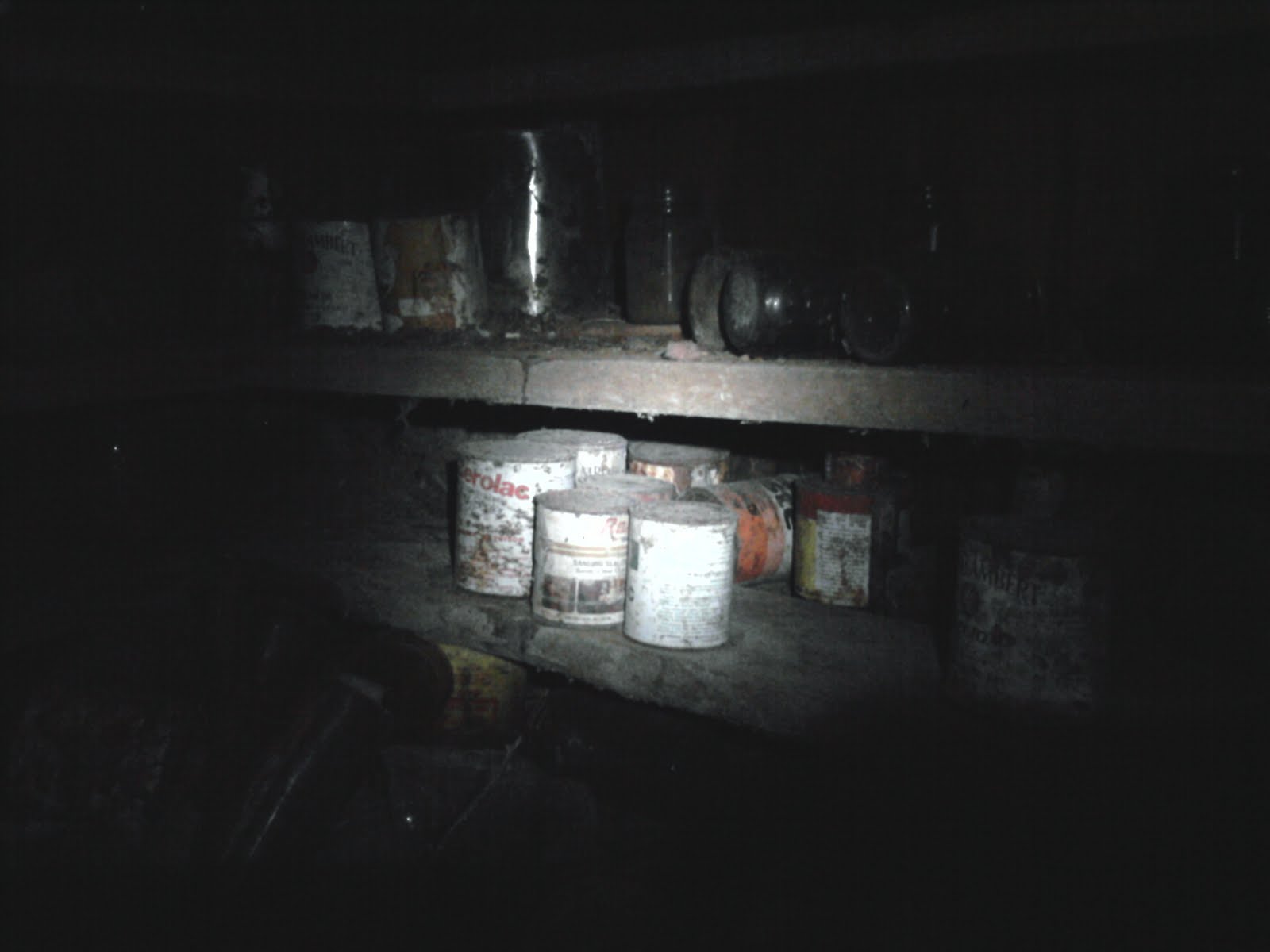
Upon taking a peek inside, I saw some glass jars and jumped to the conclusion that my first impression was correct: this is probably a root cellar. After sticking my helmeted head inside and taking a look around, I found reason for disappointment. There were more paint cans than there were food jars. Perhaps this is a toxic waste dump of some sort. (It's probably not that bad.) Furthermore, the roof had collapsed. I figure that it probably collapsed when the tree I was about to cut up fell on it.

This is not exactly what I was hoping to find

In the near future, I plan to investigate further whether this cellar can be safely repaired and used. If the roof hadn't collapsed, it would be about three to four feet above the floor. The room was probably about six feet or so by about four feet or so. It's certainly not a large area, but it is a start. I can't wait to see what the possibilities are.

We have an unfinished pole barn on our property. A robin has been trying to build a nest at various inappropriate places on our house, and after being harassed by us, finally built a nest in the barn. As I was retrieving something from the barn, I heard a whole lot of tweeting going on. I looked up to see three mouths expecting food.
Some robins nesting in our barn
I can't imagine ever having this kind of fun in the city. With every new day at our country home, I am enjoying it more and more.


Sunday, August 14, 2011

Garden Update for August 2011

Our garden is coming along nicely. Over the last few weeks, we've tilled another area (by hand) in preparation for next year. Since it is slightly inclined, I'm thinking about leveling it a bit. But I've seen plenty of fields that aren't perfectly flat, so I'll try planting it the way it is and see how it works out. I tried planting some quickly maturing tomato and eggplant seeds that are a few years old in the new garden area, as well as some pickling cucumber plants I picked up at a local farmers market. Unfortunately, a deer came, removed the netting, which was held down by rocks, and ate an entire cucumber plant the next night. So I went and got some tent stakes and haven't had any more problems...yet.

I'm impressed with the kale plants. The plants that were eaten by an animal a while back have regrown and are almost ready for harvesting again. We should have plenty of kale in another month or so. Our cabbage is just about ready to harvest, too. The temperature is consistently in the 80s during the day now and in the low 50s at night. I've recently learned that cabbage plants like a steady soil temperature. I should have used mulch to help with that. When the temperature fluctuates so much, the cabbage growth bursts and the heads will split. Mine haven't split too much, but I see that some of the leaves have cracked. I'll keep that in mind for next year. The way the grass grows around here, it shouldn't be hard to make mulch, once we get a gas powered lawn mower instead of the reel mower we've been using.

Cabbage is almost ready and notice how pretty the kale is.
The largest kale plants are the ones that were completely
eaten before.
And finally our cherry tomatoes are producing nicely. I'm sure once we amend the soil properly we'll get an even higher yield. One or two of them have a tinge of yellow on them, so I'm getting excited! Super Sweet 100 is probably my favorite variety of grape tomato so far as taste goes. I'm very happy with what we're seeing for having put so little work into it. We've weeded three times now.


Super Sweet 100. My mouth waters just
thinking about them.


What in Tarnation?

About two weeks ago, my wife noticed a plant on our property that looked, well, suspicious. If it were just the one, that would be easy, dig it up, throw it away, and nobody would know any better. But maybe there were others. We started looking around our yard and found there were probably hundreds of these plants. We started to get worried. How do we discreetly rid ourselves of hundreds of these plants. And can we possibly find and destroy all of them? Burning might not be such a good idea. This is the plant I'm talking about:

I hope this plant isn't what it looks like
After a not so restful night we decided to study this plant further. Maybe it wasn't what we thought it was. Maybe it was a look-alike. Then we found several flowering plants. This should help us to positively identify the plant. The flower looked like this:


It turns out that it is illgal to not remove this plant if it is on your property in certain counties in Montana. Fortunately, we don't live in Montana, as getting this many plants under control quickly would be a real chore. I checked our state's list of weeds that homesteaders are required to control, and this plant was not on the list. However, it is an invasive and noxious weed brought to the northwestern United States from Europe about a century ago that is quite prevalent in the area. It is spread by seed which can number over 1000 per plant, which can be transported throughout the region in hay. The plant is called sulphur cinquefoil. It is a type of rose and has a woody root that should be removed along with the plant to prevent it from growing back.

We are so relieved that this plant isn't what we though it was. This stuff is growing along side the road going through our property, not just by the house. This situation also got us thinking about what we would do if we were to find an illegal plant, or worse, a whole field or forest full of them. I guess self-reporting might bring a lighter penalty than if your neighbor makes a report to the police. But if the police started visiting all the neighbors on our account, it might not make a good impression, considering we haven't met all of them yet. Becoming more independent is making me learn a lot more and think a lot more than I used to.

Thursday, July 21, 2011

Garden Update #2 for July 2011

Well, it finally happened. Our kale was eaten while we were gone for the weekend. And what was left was eaten again a few days later. I suspect it was the rabbits that we see almost every day, as I didn't see any new hoofprints in the garden. I'm disappointed, but it's my own fault really, I should have covered it with netting. So I've planted some more. It only takes 60 days to mature and is cold hardy should winter come very early this year. I happen to like kale a lot, so I planted almost four times as much as I had before.

What's left of my first planting of kale.
Another two weeks or so and it would
have been ready to harvest.

There is a lovely wilted kale salad that we like to make, so there is no need to worry that there will be too much. There is also some green fruit on our cherry tomato plants, which will go quite nicely in our wilted kale salad.

While I was working in the garden, I spotted fruit on the wild strawberry plants that cover a large part of our yard like grass. I tasted some, and they are quite tart--not at all desirable for eating. But they smell very nice and might make a nice fragrance for some homemade soap. We haven't made any soap yet, but would like to some day when the renovation slows down. I've been told that if I want to grow strawberries to eat, I need to get rid of all these wild plants because they will cross with my good ones and ruin my crop. Hmmm... more work to do. These wild plants are everywhere here.

Wild strawberries from the yard. These berries are very
small. That dish is the size of a small cupcake.

Resources
James Russell's Wilted Kale Salad recipe: http://therawchef.blogs.com/russell_james/2006/11/wilted_kale_sal.html

Monday, July 11, 2011

Our Water System

Many people, especially city folk who aren't used to living with a well, are intrigued by our water system. This post is to help them understand what I'm talking about when I mention our water tank.

This system was put in place before we bought the house, and it works reasonably well, allthough I would like to make a few changes to increase reliability and availability.

We have a relatively shallow well--only 75 feet deep with the static level at about 20 ft. However, the well, on average, produces only about 4 gallons per minute (as observed during a flow test during a winter home inspection). That's an average of 4 gallons per minute, that is not a continuous flow. In reality, we can pump about 150 gallons out of the well at a much faster rate before it slows to almost nothing, then resumes again for a minute or two a few minutes later. If pumped continuously, the flow will start and stop every few minutes. This is not ideal for on-demand water use in the home. Furthermore, the well pump requires 120V AC and draws quite a bit of current, making it not feasible to run the well pump off of the house battery bank.

To solve this problem, a previous owner installed a 350 gallon storage tank inside the house. The tank is filled via underground pipes while the well pump is powered by the generator. I actually plug a cord into an outlet on the generator to fill the storage tank. This takes about 20 minutes and I only need to do it about every two or three days, and only sometimes more frequently.

Our indoor water storage tank, next to our efficient washing machine.

To provide pressure in the house, a 12V DC pump pressurizes a small tank to 80PSI. When the pressure in that tank gets down to about 40PSI, the pump pressurizes the tank again to 80PSI. The pressure pump runs off of the house battery bank and provides adequate pressure for household water use at conventional water taps through out the house, including shower, toilets, sinks, washing machine, and outdoor spicket. Hot water is provided with a propane-burning instant (tankless) hot water heater which uses electricity only to light the propane and to power the thermostat. So far it has worked well.

Pressure pump and tank

I would like to make some improvements. The underground pipes are not deep enough to prevent freezing in the winter. This may be because there is a lot of granite in the ground in the vicinity of the house. But it's also because the water pipes enter the well above ground where there is definitely the potential for freezing. I'd like to have these pipes enter the well casing under ground. I'd then like to put a hand pump on top so that we can still get water if something should happen to the well pump.

The insulation on these pipes is no match for the cold
winters here. They need to be underground.

I'd like to replace the 120VAC well pump with a DC pump that can run on power produced by solar panels. That way when the generator breaks down again, we can still get water out of the well.

And finally, I'd like to add some sort of water-level detection mechanism that can turn the well pump on when the water level in the storage tank gets to a certain level and then off again when it's full.

Garden Update for July 2011

feOur tiny garden is coming along quite nicely, except for the peppers. I think they might need more water or something as they always look a little dry by the end of the day. The cabbage looks like it will be ready by the end of the month or so, and the kale is coming in quite nicely.  The tomatoes have flowered. I really haven't put in much effort into the garden at all. Just watering every day and fertilizing once a week.

I'm really happy that I haven't had to do any serious weeding yet. I know this will make some of my gardening friends jealous, but I'm pretty sure that whoever tended this plot before me must have done a good job of getting rid of weeds. I suspect that when I expand for next year, I may have more weeding to do.

The netting seems to be working. I have seen deer hoof-prints in the garden, and I see deer around the house frequently, but so far, nothing has been eaten in the garden. Maybe we are just growing foods that deer don't like? At any rate, I'm happy the deer are not being pests this year.

Here's a picture of our cabbage and kale:

Cabbage and kale are doing great!


Thursday, July 7, 2011

Returning to the 21st Century By Installing a Washing Machine

Almost any washing machine can be used off-grid if you have a good generator. Some washers are more efficient than others, though, and if you want to run the washing machine off the solar panels, more efficient is definitely better.

There are a number of options for washing clothes off-grid, and I'll talk briefly about each of them:
  • Fully manual: This includes beating against rocks in a creek (your downstream neighbors might not appreciate this, so not recommended), washing in a tub with a scrubber, the old plunger-and-five-gallon-bucket... You get the idea.
  • Wringer washers: I hear these are pretty reliable and quite efficient with water, especially if you do multiple loads using the same water, starting with the least soiled clothes. These machines are typically obtained (well) used, but they are making a comeback and are being manufactured again. They are available with hand-powered or electric wringers.
  • Conventional late 20th century washing machines: Most were not built with energy- or water-efficiency in mind. If you want a conventional washer, get a modern one.
  • Staber washing machines: These come highly recommended by those living off-grid because they are efficient and easy to repair. However, after reading user comments on the web, it seems to me that they need more repairs (easy or inexpensive as they may be) than a washing machine should need. They also cost more than modern washing machines. If sustainability is important to you or you are so remote that it could take a long time to get a replacement part, seriously evaluate this option.
  • Modern high-efficiency washers: Today's front-loading (and even some top-loading) washing machines are very water-efficient, and many are very energy-efficient, too. These modern washing machines do cost more than the least expensive models available, but the water- and energy-saving features pay for themselves in very short order when living off-grid.
We felt that the positive aspects of a Staber washer did not justify the expense for our situation. We opted for the most energy efficient front-loading washer available at Home Depot, which turned out to be an LG WM2140CW. This machine (or previous years' models) was rated highly by users and seems to be quite reliable. Should the washing machine fail we will resort to washing at a laundromat in town or we will use the five-gallon bucket and plunger. We also purchased the extended warranty because it covers power surges, and the store sales person assured us that any mishaps caused by running off a generator would be covered.

Our experience with the washer has been very good for the month that we've had it. Electricity usage is very low and I think I may be able to run it off of our soon-to-be-installed 460 watt solar array during the peak power period. Usually, motors don't work well with modified sine wave inverters like we have, but when started accidentally once without the generator running, it seemed to work just fine. It is possible to install a capacitor to smooth out the starting surge created by many motors. I haven't done this yet, but will investigate if it is needed after I get the solar panels installed. Water usage is also quite good, using about the same or less than would be used by a 10-minute shower. Another nice feature of this washer is its high-speed spin cycle which leaves most clothes pretty dry, reducing the amount of outdoor drying time required.

Water efficiency is also an important factor. Most people don't realize this, but more than one fourth of the energy produced in the United States is used to pump water. When you are off-grid, you need to consider the energy cost of the water you use. If you have a deep well and need to run a generator to pump water out of it, then filling a top-loading agitating washer a few times per load of laundry can cost quite a bit more in fuel than would using a front-loading washer which uses one fifth as much water as a top-loading machine. If you have more water than you know what to do with coming out of the spring uphill from your house, consider yourself blessed, you have some really cheap water. But for the rest of us, the cost of water is an important consideration.

Resources
Staber washing machines: http://www.staber.com/
LG washing machines: http://www.lg.com/us/laundry/index.jsp
Lehmans has lot's of off-grid appliances. Washers here: http://www.lehmans.com/store/Home_Goods___Laundry___Washing?Args=&view_all=&sort_by=